There are many breathtaking human achievements in the world, but very few possess a history as deep and stubborn as the Corinth Canal. For the majority of international travelers visiting Greece, the Isthmus is simply a beautiful photo-stop during a road trip toward the Peloponnese. Yet, behind those steep, vertical limestone walls lies an engineering dream that took nearly 2,000 years, dozens of emperors, and tons of dynamite to finally become reality.
At Time For Trip, we specialize in premium, private passenger road transport with professional drivers to every major historical and cultural destination across Greece. To help you understand why this landmark captivates every visitor, let’s take a journey back through time, uncovering the names, dates, and historical events that shaped the canal.
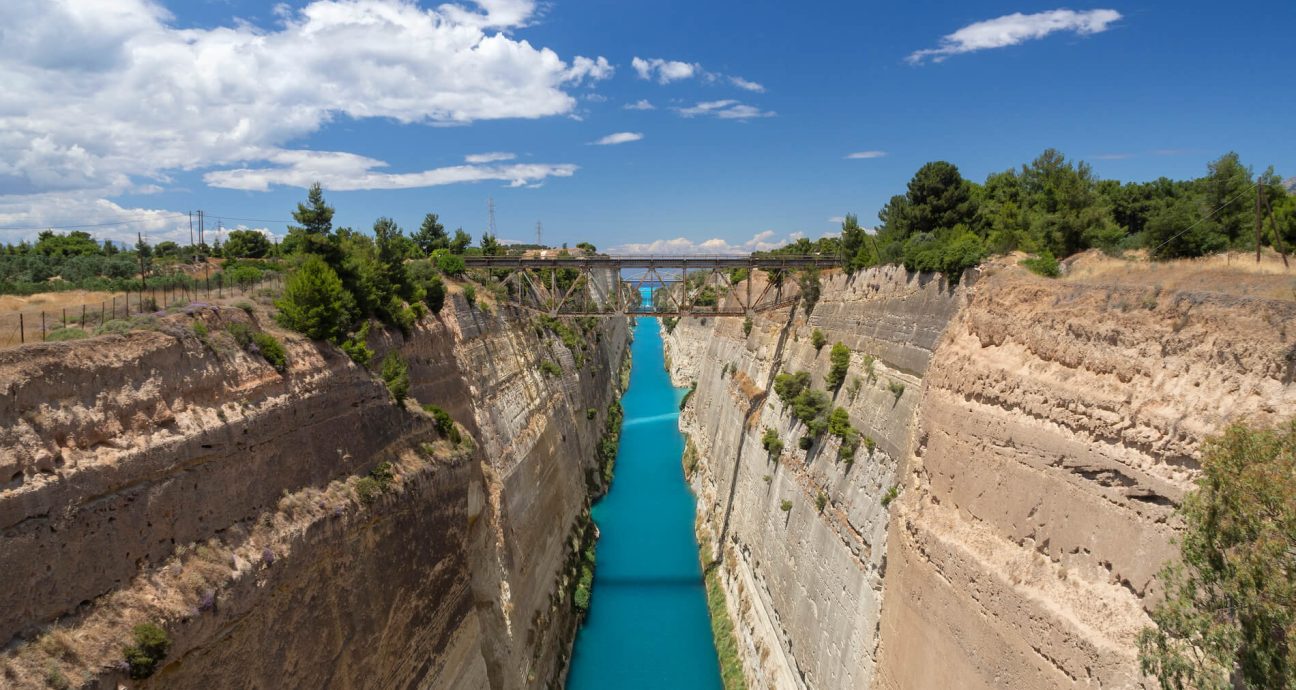
• Engineering Milestone: Connecting the Saronic Gulf with the Corinthian Gulf, the Corinth Canal spans 6.3 km with rock walls rising up to 79 meters, completed in 1893 after 2,000 years of historical attempts.
Antiquity: The Vision and the "Diolkos"
The core idea of connecting the Saronic Gulf with the Corinthian Gulf was born from a practical maritime necessity: enabling sailors to bypass the notoriously dangerous and time-consuming circumnavigation of the Peloponnese peninsula (avoiding the treacherous winds of Cape Maleas).
Periander (602 BC)
The very first person to seriously contemplate cutting through the Isthmus was the Ruler of Corinth, Periander, in 602 BC. However, he quickly abandoned the project. The technical limitations of the era were immense, and ominous warnings from the Delphic oracle—who claimed that altering geography would invite the wrath of the gods—deterred him. Instead of a canal, Periander constructed the Diolkos: a paved trackway lined with timber, upon which ships were greased with fat and manually hauled overland from one side of the Isthmus to the other.
Demetrius the Besieger (307 BC)
Three centuries later, in 307 BC, the Macedonian king Demetrius the Besieger brought in expert Egyptian engineers to restart the excavation. However, the engineers committed a massive mathematical error in their calculations: they believed that the sea level in the Corinthian Gulf was significantly higher than that of the Saronic Gulf. They warned that breaking the land would cause a catastrophic flood, submerging the island of Aegina and surrounding regions. The project ground to a halt once more.
The Roman Period: The First Shovel
With the rise of the Roman Empire, interest in the Isthmus was instantly revitalized. Major political figures like Julius Caesar and Emperor Caligula drafted architectural blueprints, but both met untimely ends before breaking ground.
Emperor Nero (67 AD)
The historical figure who came closest to completing the canal in antiquity was Emperor Nero in 67 AD. He personally inaugurated the excavation using a golden pickaxe, commanding thousands of workers to dig. The workforce successfully excavated a stretch of nearly 2 kilometers. However, that very same year, a major rebellion erupted in Rome. Nero was forced to return to the capital, leaving the canal half-finished for centuries to come.
The 19th Century: Completion
It took nearly 1,800 years for humanity to pick up the shovels again. Following the establishment of the modern Greek state, the country's first Governor, Ioannis Kapodistrias, evaluated the project in 1830, but the financial cost was impossible for the young nation to bear alone.
The Era of Industrial Engineering (1881 - 1893)
The definitive decision was eventually authorized by the government of Alexandros Koumoundouros and executed under Prime Minister Charilaos Trikoupis.
- In 1881, a consortium led by French General Etienne Tyrr and Hungarian engineer Béla Gerster initiated construction utilizing the heavy machinery of the Industrial Revolution and massive amounts of dynamite.
- Due to complex financial restructuring, the project was ultimately completed by a Greek construction firm spearheaded by Andreas Syngros.
- On July 25, 1893, the official grand opening took place with grand ceremony. The 2,000-year-old dream was finally a reality: a channel measuring 6.3 kilometers in length, 8 meters in depth, with vertical rock walls reaching up to 79 meters in height.
Travel the Peloponnese in Ultimate Comfort with Time For Trip
Today, the Corinth Canal is much more than a maritime transit lane; it stands as a monument to human determination. The experience of standing on the pedestrian bridge, looking down into the sheer canyon, and watching the two seas connect beneath your feet is unforgettable.
If you are planning a custom road itinerary outside of Athens, moving your family or corporate group does not have to be an exhausting route coordination puzzle. At Time For Trip, we provide executive passenger transportation designed around your schedule:
- Separate, dedicated luggage compartments where travel bags and equipment are securely stored, leaving the passenger cabin open and comfortable.
- Powerful climate control and comfortable seating suited for long-distance highway travel across the Peloponnese.
- Experienced, licensed professional chauffeurs who manage highway navigation and punctuality seamlessly. Learn more in our fleet guide.
You can utilize our private transportation services to combine your stop at the Corinth Isthmus with a visit to the ancient citadel of Mycenae, a stroll through the seaside streets of Nafplio, or a private drive to the renowned boutique wineries of Nemea and Ancient Nemea.
We regularly include the Isthmus as a featured highlight in our curated regional day trips, such as our dedicated Corinth and Loutraki tour, the comprehensive Argolis tour, and our signature road trip to Ancient Olympia. You select your destinations, and we ensure you travel with comfort and safety.
Frequently Asked Questions (FAQ)
How long is the drive from Athens to the Corinth Canal?
The drive from central Athens to the Corinth Canal takes approximately 50 to 60 minutes via the modern Olympia Odos (A8) motorway under normal traffic conditions.
Can we combine a Corinth Canal stop with other destinations in the Peloponnese?
Yes. The Corinth Canal is typically the primary scenic stop on custom day tours heading toward the archaeological site of Mycenae, Epidaurus, the historic coastal town of Nafplio, or the vineyards of Nemea.
How is group transportation handled for these private regional tours?
We provide executive chauffeured minibuses equipped with dedicated luggage compartments and full climate control, driven by licensed professionals experienced in mainland touring routes.
Plan Your Peloponnese Journey Today
Ready to discover the historic gateways of Greece? Contact Time For Trip today to receive your custom transport offer, and let our experienced team manage your journey with complete comfort and reliability!